
Uncategorized, Walk Through Metal Detectors
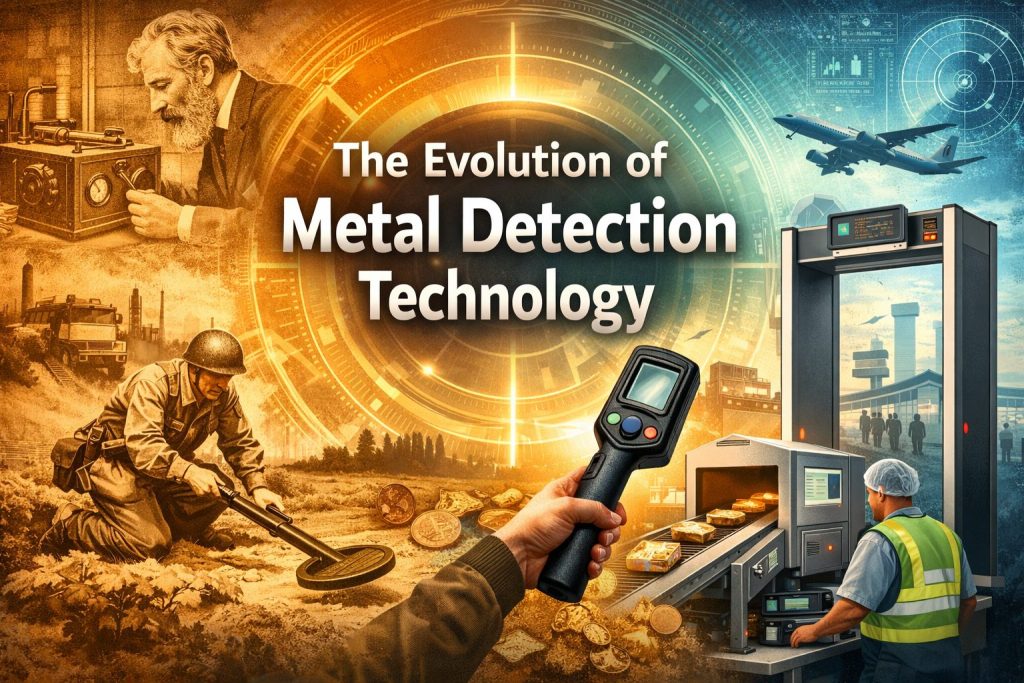
The Evolution of Metal Detection Technology: Complete Guide
Mar
Metal detection has come a long way from simple experimental devices to advanced systems used in security, industry, and research. Understanding the history of metal detectors helps explain how today’s tools became faster, more accurate, and easier to use.
This blog explores the timeline of metal detection technology, key breakthroughs, and how changing needs shaped its development. From early scientific experiments to modern digital systems, the journey reflects a steady process of innovation driven by safety, efficiency, and precision.
Why Metal Detection Technology Matters
Metal detection plays an important role in many areas of daily life. It supports safety in public spaces, quality control in manufacturing, and exploration in fields such as archaeology and mining.
As demand for reliable screening grew, technology advanced to meet new challenges. Each stage in the history of metal detectors shows how improvements in electronics, computing, and materials science helped expand what these devices could do.
Early Experiments in Metal Detection (1800s)
The first attempts to detect metal electronically began in the late nineteenth century. Inventors explored the idea of using electromagnetic fields to identify hidden objects.
One of the earliest known devices was created by Alexander Graham Bell in 1881 to locate a bullet in the body of a patient. Although the device had limited success, it demonstrated the potential of electromagnetic detection and marked a key milestone in the history of metal detectors.
These early models were large, fragile, and not practical for everyday use. However, they laid the groundwork for future improvements.
The Rise of Practical Detectors (1920s–1940s)
Mining and Industrial Use
Mining companies used early detectors to locate mineral deposits. Industrial facilities also adopted them to detect metal contaminants in production lines.
Military Applications
World War II accelerated innovation, as detectors were used to locate landmines. The need for reliable equipment led to significant improvements in sensitivity and durability.
These developments marked a turning point in the tech evolution of detection systems, moving them closer to modern designs.
Expansion into Civilian Use (1950s–1970s)
Hobby and Treasure Hunting
Portable detectors gained popularity among hobbyists searching for coins, relics, and artifacts. This period helped build public awareness of the technology.
Construction and Utility Work
Detectors were also used to locate underground pipes, cables, and structural elements. This reduced damage during excavation and improved safety.
The growing variety of uses reflected broader industry trends, showing how technology adapts to new needs.
Digital Revolution and Improved Accuracy (1980s–1990s)
The introduction of digital electronics changed metal detection significantly. Microprocessors allowed devices to process signals more accurately and filter out interference.
- Better discrimination between metal types
- Adjustable sensitivity levels
- More stable performance in different environments
These advancements made detectors more reliable and easier to operate. The period also saw increased use in airports and public security settings.
The digital era represents a major milestone in the history of metal detectors, as it shifted systems from analog to computer-assisted designs.
Modern Metal Detection Technology (2000s–Present)
- Enhanced Detection Capabilities: Multi-frequency technology allows devices to detect a wider range of metals with higher precision.
- Integration with Other Systems: Metal detectors can now connect with access control, monitoring software, and data analytics platforms.
- Portable and Specialized Designs: From handheld scanners to large walkthrough systems, equipment is designed for specific applications.
Current tech evolution continues to focus on improving speed, reducing false alarms, and enhancing user experience.
Metal Detection in Security and Public Safety
Security screening is one of the most visible uses of metal detection today. Airports, stadiums, and public buildings rely on screening systems to identify prohibited items.
Modern detectors are designed to handle high traffic while maintaining accuracy. Improvements in signal processing help reduce false alerts, allowing security staff to focus on genuine risks.
As public safety needs grow, industry trends show increasing investment in faster and more reliable screening solutions.
Industrial and Commercial Applications
Metal detection also plays a key role in manufacturing and quality control. Food processing plants use detectors to identify metal fragments, protecting consumers and meeting safety standards.
In recycling facilities, detection systems help sort materials more efficiently. Mining operations continue to rely on advanced detectors to locate valuable resources.
These applications highlight how the history of metal detectors reflects a balance between safety, efficiency, and productivity.
Key Innovations That Shaped Metal Detection
- Electromagnetic Induction – The core principle behind most detectors.
- Pulse Induction Technology – Improved detection in challenging environments.
- Digital Signal Processing – Enhanced accuracy and filtering.
- Wireless Connectivity – Enables remote monitoring and updates.
Each innovation contributed to the steady tech evolution of the technology, making devices more capable and versatile.
Challenges and Limitations Over Time
- Interference from surrounding materials
- Environmental factors such as soil composition
- Balancing sensitivity with false alarm rates
- Cost and maintenance requirements
Addressing these issues has driven research and development across decades, shaping modern designs.
Future Directions in Metal Detection
The future of metal detection is likely to focus on smarter systems and improved automation. Emerging technologies include artificial intelligence for signal analysis and advanced sensors that improve detection accuracy.
- Faster scanning for high-traffic environments
- More portable and energy-efficient devices
- Integration with broader safety systems
These innovations reflect ongoing industry trends toward smarter, connected technologies.
Timeline Summary: From Early Devices to Modern Systems
- 1800s: First experimental detectors developed
- Early 1900s: Practical applications in mining and industry
- 1940s: Military use drives innovation
- 1950s–1970s: Expansion into civilian and commercial use
- 1980s–1990s: Digital technology improves accuracy
- 2000s–Present: Integrated, high-performance systems
Conclusion
Metal detection technology has evolved from simple experimental tools to sophisticated systems used across many industries. Each stage of development brought improvements in accuracy, portability, and usability.
Understanding the history of metal detectors helps us appreciate how innovation responds to real-world needs. As technology continues to advance, metal detection will remain an essential tool for safety, quality control, and exploration.
FAQs
1. When were metal detectors first invented?
The earliest experimental device appeared in the late 1800s, with practical versions emerging in the early twentieth century.
2. What industries use metal detection today?
Security, manufacturing, mining, food processing, construction, and research all rely on metal detection technology.
3. How have metal detectors improved over time?
Advances in electronics and software have increased accuracy, reduced false alarms, and made devices more portable.
4. What is the main principle behind metal detection?
Most detectors use electromagnetic fields to identify the presence of metal objects.
5. What does the future hold for metal detection technology?
Future systems are expected to include smarter sensors, faster processing, and better integration with other technologies.
