
Walk Through Metal Detector vs. Handheld Wand: Which Do You Need?
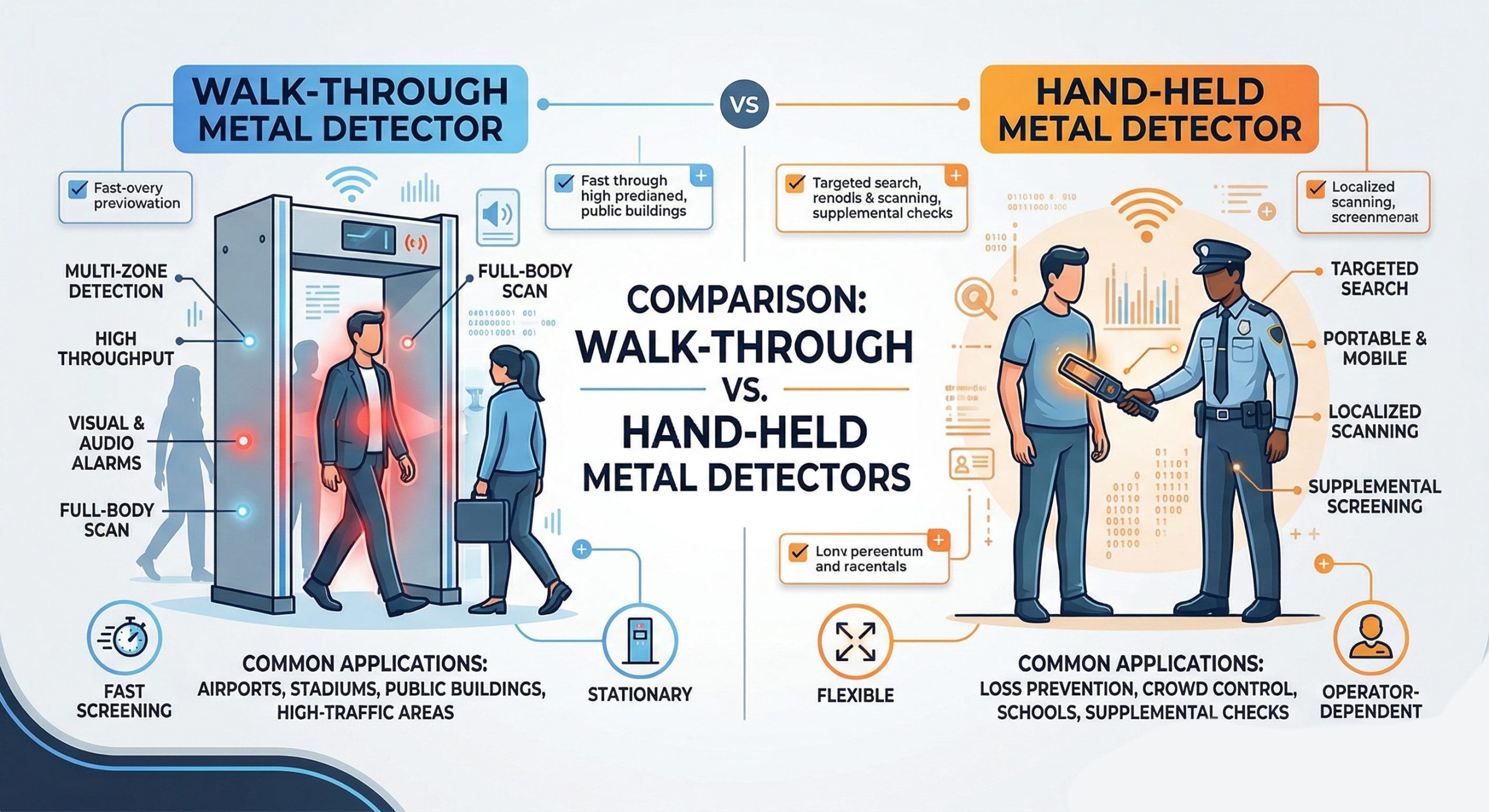
Walk Through vs. Handheld: Quick Comparison
| Feature | Walk-Through Detector | Handheld Wand |
|---|---|---|
| Cost | $2,176–$7,647 | $50–$400 |
| Screening speed | 20–60 people/min | 1–3 people/min |
| Hands-free screening | ✅ Yes | ❌ No |
| Portability | Semi-portable to permanent | Fully portable |
| Body-location accuracy | High (33–66 zones) | Very high (operator-guided) |
| Staff required | 1–2 officers to monitor | 1 officer per wand |
| Power required | Yes (110V outlet) | Battery powered |
| ADA compliance | Requires ADA-compliant lane | Flexible |
| Best for primary screening | ✅ Yes | ❌ Not efficient |
| Best for secondary screening | ❌ Not applicable | ✅ Yes |
How Walk-Through Metal Detectors Work
Walk-through detectors generate a pulsed electromagnetic field that fills the archway opening. When a person carrying metal passes through, the metal disturbs the field and triggers an alarm. Modern units with 18–66 detection zones can pinpoint exactly where on the body the metal is detected — dramatically reducing false alarms and speeding secondary screening.
Walk-throughs are designed for primary screening of high-volume foot traffic. They allow security staff to monitor dozens of people per minute without touching anyone, maintaining dignity and throughput simultaneously.
How Handheld Wands Work
Handheld metal detector wands use the same electromagnetic induction technology in a portable, hand-held form factor. The security officer moves the wand over the person’s body — when it passes over a metallic object, it emits an audible tone and/or vibration.
Wands are highly targeted: the officer controls exactly what area is scanned. They’re ideal for secondary screening after a walk-through alarm, or in situations where a full archway isn’t practical.
When to Use a Walk-Through Metal Detector
Walk-through detectors are the right tool when:
- High foot traffic: You’re screening more than 20–30 people per hour. Wanding everyone individually simply isn’t feasible.
- Permanent or semi-permanent installation: Schools, courthouses, government buildings, stadiums, and arenas need a permanent checkpoint solution.
- Hands-free screening required: Privacy regulations and dignity standards may require that everyone pass through without being touched unless there’s cause.
- Consistent coverage: Walk-throughs screen every person who passes — there’s no human error or selective screening.
View PTI’s recommended walk-throughs for schools and courthouses.
When to Use a Handheld Wand
Handheld wands are the right tool when:
- Secondary screening: After a walk-through alarm, an officer uses a wand to precisely locate the metal on the individual’s body.
- Low volume screening: For small events or selective screening, a wand is practical and far less expensive.
- No power source available: Battery-powered wands work anywhere — outdoor events, parking lots, remote locations.
- Budget constraints: A $100–$400 handheld wand provides basic metal detection capability when a $3,000 archway isn’t justified.
- Targeted screening: When you want to check a specific person or area, the wand gives you precision control.
The Standard Setup: Using Both Together
The most effective security checkpoint uses both a walk-through detector and handheld wands:
- Everyone passes through the walk-through archway (primary screening)
- If the archway alarms, a secondary officer uses a wand to locate the source
- The officer determines whether it’s a threat or a benign item (belt, phone, medical implant)
This is standard protocol in schools, courthouses, airports, and stadiums worldwide. The walk-through handles volume; the wand handles precision. Together, they deliver fast, accurate, dignified screening.
Cost Comparison
For a basic checkpoint, budget:
- Walk-through archway: $2,176–$7,647 (one-time purchase)
- Handheld wands (2): $200–$800 (one-time)
- Accessories (trays, stanchions): $200–$500
- Total checkpoint setup: approximately $2,600–$9,000
For events and temporary needs, consider PTI’s rental program, which includes both archways and wands.
Our Recommendation
For any facility expecting more than 20 visitors per hour through a security checkpoint, a walk-through detector is essential. Pair it with 1–2 handheld wands for secondary screening. The most popular combo for schools and courthouses: the Zorpro 33 Zone archway ($3,287) plus a pair of Garrett SuperScanner wands.
If you’re planning a one-time event or mobile security operation, the Garrett MZ 6100 ($3,577) with handheld backup is the professional’s choice.
Frequently Asked Questions
Can a handheld wand replace a walk-through metal detector?
For low-volume screening, yes. For any facility with consistent foot traffic (schools, courthouses, venues), no — wanding everyone individually is too slow and inconsistent. Walk-through detectors provide automated, objective, high-throughput screening that wands can’t match.
Do I need both a walk-through detector and a handheld wand?
Yes, in most cases. Walk-through detectors trigger alarms but don’t always tell you exactly where the metal is. Handheld wands allow officers to precisely locate the source. The two tools are designed to work together, not as alternatives.
Which is more accurate — a walk-through or a handheld wand?
A high-zone walk-through (33–66 zones) provides excellent body-region accuracy. A handheld wand, used by a trained officer, provides the highest precision because the officer can sweep exactly where they need to. For pinpoint accuracy, the wand wins — but for speed and consistency, the walk-through wins.
Are there combination units that include both?
Some manufacturers sell wands packaged with walk-through units. PTI can quote bundled packages. Contact us for custom package pricing.
Related Resources
- Walk Through Metal Detector Price Guide [2026]
- Best Walk Through Metal Detectors [2026 Buyer's Guide]
- Walk Through Metal Detector Comparison Chart
- How Do Walk Through Metal Detectors Work?
- Walk Through Metal Detector vs. Handheld Wand
- Walk Through Metal Detector Setup & Installation Guide
Ready to buy or get a quote? Browse our full walk through metal detector lineup →