
How Do Walk Through Metal Detectors Work?
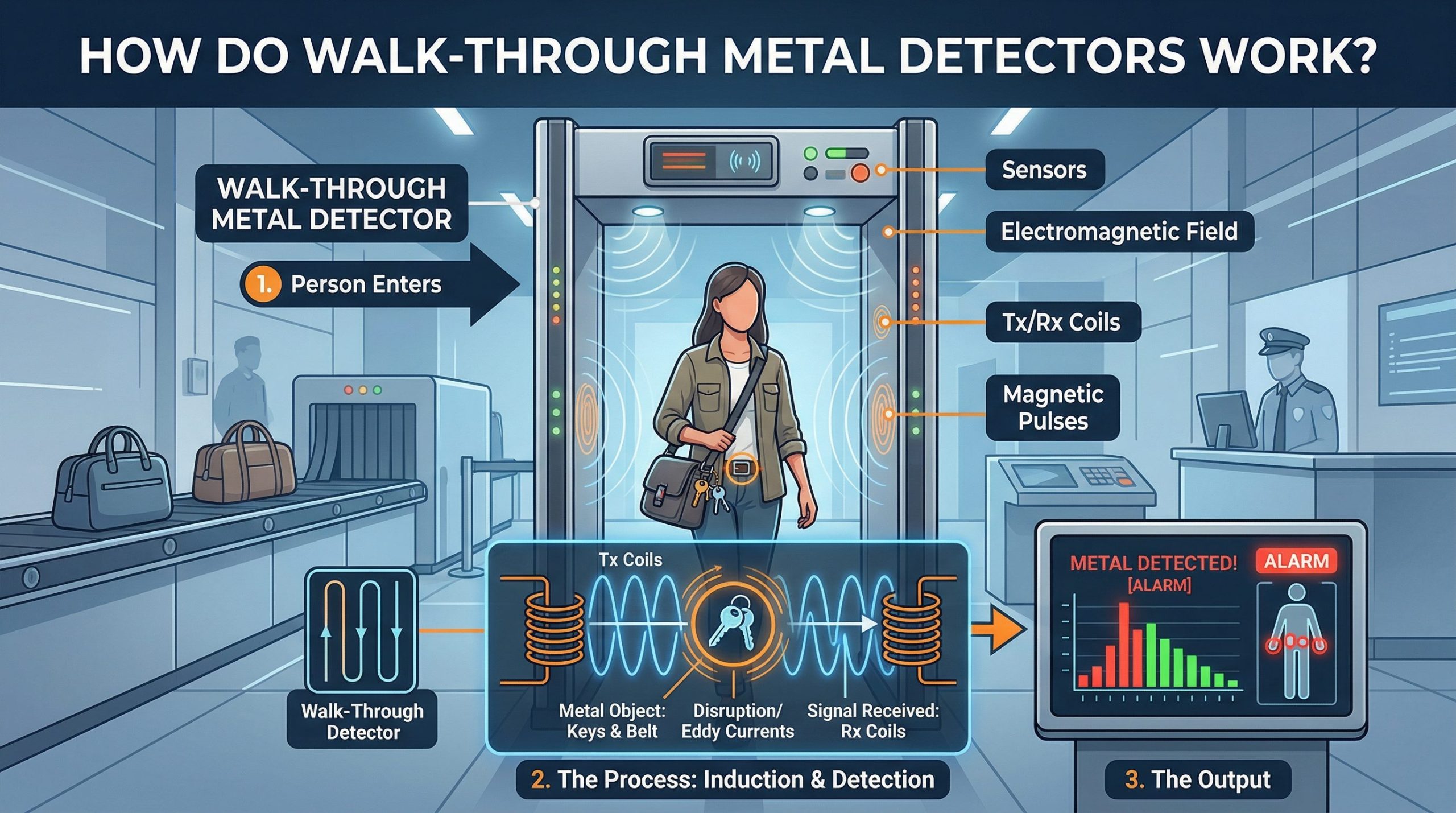
The Short Answer: Electromagnetic Induction
Walk through metal detectors work by generating a pulsed electromagnetic field. When a person carrying metal passes through the archway, that metal disturbs the field — and the detector’s receiver coils sense the disturbance, triggering an alarm. The entire detection process happens in milliseconds.
This technology — called pulsed induction (PI) or very low frequency (VLF) detection — has been the backbone of security screening for over 50 years, and modern multi-zone detectors have refined it to a high science.
How Electromagnetic Induction Works
Inside every walk-through archway, there are two key components:
- Transmitter coils — These generate a continuous or pulsed electromagnetic field that fills the space inside the archway.
- Receiver coils — These continuously monitor the field for any disturbance.
When a metallic object passes through, it creates a secondary electromagnetic field (called an eddy current) that opposes the original field. The receiver coils detect this opposition and signal the control panel that metal has been detected.
Modern detectors are calibrated to ignore minor environmental interference (nearby HVAC systems, reinforced concrete floors, etc.) while remaining sensitive enough to detect concealed handguns, knives, and other metallic threats.
Walk Through vs. Other Detection Methods
| Method | Technology | Detects | Best Use |
|---|---|---|---|
| Walk-Through Metal Detector | Electromagnetic induction | Metal only | High-volume people screening |
| Handheld Wand | Electromagnetic induction | Metal only | Secondary screening, targeted |
| X-Ray Machine | X-ray imaging | All objects (by density) | Bag/baggage screening |
| Millimeter Wave Body Scanner | Millimeter wave radio | Metal and non-metal threats | Airport full-body screening |
Walk-through metal detectors are the right tool for people screening — fast, non-invasive, and highly effective at detecting concealed metallic weapons. For baggage, you need X-ray. For non-metallic threats (ceramic knives, drugs), you need body scanners or K9 units.
What Walk Through Metal Detectors Can — and Can’t — Detect
Can Detect:
- Handguns and pistols (steel frames, cylinders, barrels)
- Rifles (metallic components)
- Knives and blades (any significant metallic content)
- Brass knuckles
- Large amounts of metallic contraband
- Improvised metallic weapons (pipes, shanks)
Cannot Detect:
- Ceramic or plastic weapons
- Drugs or non-metallic contraband
- Explosives (unless they contain metallic detonators)
- Very small amounts of metal (tie tacks, watch bands — calibrated out)
- Liquids
Modern detectors are calibrated to ignore common metallic items people carry every day — belt buckles, keys in a pocket, eyeglass frames — while still detecting firearms and large blades. This calibration is known as target discrimination, and it’s what separates a professional-grade detector from a cheap model that alarms on everything.
Single-Zone vs. Multi-Zone Detection: Why Zones Matter
A zone is a horizontal detection layer within the archway. Think of it as slicing the archway into horizontal bands, each of which can independently sense metal.
- 1–6 zones: Basic detection — tells you metal is present, but can’t pinpoint location
- 18 zones: Body region detection — can distinguish upper body from lower body, left side from right
- 33 zones: Precise body location — “left hip, mid-torso” — significantly reduces false alarms and speeds secondary screening
- 66 zones: Maximum precision — used in federal facilities and airports for pinpoint location data
Why does this matter operationally? When every alarm sounds the same, security officers must manually wand-scan the entire body. With 33 zones, the detector tells the officer exactly where to look — reducing screening time from 45 seconds to under 10 seconds, and cutting the false alarm rate significantly.
Sensitivity Levels: What the Numbers Mean
Walk-through detectors allow security operators to dial in sensitivity levels — typically on a scale of 0–999 or 1–100 depending on the model. Higher sensitivity detects smaller metallic objects; lower sensitivity is used to avoid alarming on everyday items like belt buckles and watches.
In practice, sensitivity is set by:
- Starting at a moderate level
- Running test personnel through (with and without known metallic items)
- Adjusting until legitimate threats alarm consistently while nuisance items do not
- Documenting the setting for consistent daily use
The Zorpro 33 Zone features a color touchscreen that makes sensitivity adjustment intuitive. The Zorpro 33 Zone allows zone-by-zone sensitivity adjustment — critical in environments where targets carry medical implants or prosthetics.
Safety: Pacemakers, Implants, and Pregnancy
One of the most frequently asked questions about walk-through metal detectors is whether they’re safe for people with medical devices.
Pacemakers and Implantable Defibrillators
Walk-through metal detectors do not emit X-rays or ionizing radiation. They produce low-level electromagnetic fields — similar in strength to a laptop computer or WiFi router. Modern pacemakers and ICDs (implantable cardioverter-defibrillators) are designed to tolerate these fields.
That said, individuals with pacemakers are typically offered alternative screening (handheld wand screening with a trained officer) as a precaution. This is standard protocol in airports and courthouses.
Pregnancy
Walk-through metal detectors are considered safe for pregnant women. The electromagnetic fields are non-ionizing and at very low power levels. Pregnant TSA employees routinely work near these devices without special health restrictions.
Joint Replacements and Metal Implants
Metal implants (hip replacements, knee replacements, surgical pins) will trigger the detector. Security officers should be trained to handle these situations graciously — documenting medical exemptions where applicable or conducting respectful wand-based secondary screening.
Walk Through Metal Detector Throughput
A single walk-through metal detector can process 20–60 people per minute under normal conditions, depending on:
- Whether people are required to remove belts, shoes, and pocket contents
- False alarm rate (affected by zone count and calibration)
- Number of secondary screening officers
- Archway width (ADA lanes allow wheelchair users to pass without secondary screening in some configurations)
For high-throughput environments (stadiums, courthouses with 500+ daily visitors), multiple lanes or a higher-zone detector that minimizes secondary screening is essential.
Which Walk Through Metal Detector Is Right for You?
| Application | Recommended Model | Price |
|---|---|---|
| Small school / budget | Zorpro 6 Zone | $2,176 |
| Large school / courthouse | Zorpro 33 Zone | $3,287 |
| Events / portable | Zorpro 18 Zone | $2,387 |
| Federal facility | Zorpro 33 Zone | $3,287 |
| High-security / airport | Ranger Intelliscan 33 Zone 66 | $4,188 |
Frequently Asked Questions
Do walk through metal detectors use radiation?
No. Walk-through metal detectors use non-ionizing electromagnetic fields — the same technology as a radio or Wi-Fi router. They do not use X-rays or any form of ionizing radiation. They are safe for everyday use.
Can walk through metal detectors detect guns?
Yes. Walk-through metal detectors reliably detect handguns, rifles, and other firearms. Steel-framed firearms are easily detected. Even polymer-framed pistols (like a Glock) contain enough metal (barrel, slide, magazine) to trigger detection.
Why do walk through metal detectors sometimes go off for no reason?
False alarms are usually caused by sensitivity being set too high, environmental interference (nearby electrical equipment), or people carrying common metal items (belt buckles, coins, keys). A 33-zone detector with proper calibration dramatically reduces false alarms compared to single-zone units.
How long does it take to walk through a metal detector?
A standard walk-through takes 2–4 seconds. If the detector alarms, secondary screening with a handheld wand adds 10–45 seconds depending on zone count and officer response. High-zone detectors (33+) speed secondary screening because they pinpoint the alarm location.
Do walk through metal detectors detect knives?
Yes — metal knives are reliably detected. Ceramic or plastic blades are not. For concealed knife detection, sensitivity must be set appropriately and officers trained on response protocols.
Browse All Walk Through Detectors
Related Resources
- Walk Through Metal Detector Price Guide [2026]
- Best Walk Through Metal Detectors [2026 Buyer's Guide]
- Walk Through Metal Detector Comparison Chart
- How Do Walk Through Metal Detectors Work?
- Walk Through Metal Detector vs. Handheld Wand
- Walk Through Metal Detector Setup & Installation Guide
Ready to buy or get a quote? Browse our full walk through metal detector lineup →