In an era where educational safety is non-negotiable, the conversation around campus security has shifted from “if” to “how.” Schools are no longer just places of learning; they are sanctuaries that require proactive protection. As we move through 2026, metal detectors for schools have evolved far beyond the clunky, intimidating grey boxes of the past. Today’s technology focuses on high throughput, AI-driven discrimination, and maintaining a welcoming environment for students.
For administrators and school boards, choosing the right school screening systems is a balancing act between rigorous safety and operational efficiency. At PTI World, we understand that every second spent in a security line is a second taken away from the classroom.
In this guide, we’ll explore the top-rated school security metal detectors for 2026, the legal and safety benefits of implementation, and how to set your campus up for success.
The Evolution of School Security: Why Now?
The primary goal of any screening system is the deterrence and detection of unauthorized items. However, the modern school environment demands more than just a “beep.”
Safety Benefits
- Weapon Deterrence: The mere presence of high-quality walk-through systems acts as a psychological barrier, significantly reducing the likelihood of someone attempting to bring a weapon onto campus.
- Peace of Mind: For parents and staff, seeing a professional security infrastructure provides a sense of physical and emotional safety, which is essential for a productive learning environment.
- Rapid Incident Response: Modern systems don’t just alert; they pinpoint. By identifying exactly where a metal object is located on a person, security teams can respond with surgical precision rather than broad, intrusive searches.
Compliance and Standards
By 2026, many districts have moved toward stricter safety mandates. Utilizing NIJ-certified (National Institute of Justice) equipment ensures that your school meets federal standards for detection sensitivity and magnetic field safety (ensuring no interference with pacemakers or other medical devices).
Best Walk-Through Metal Detectors for Schools in 2026
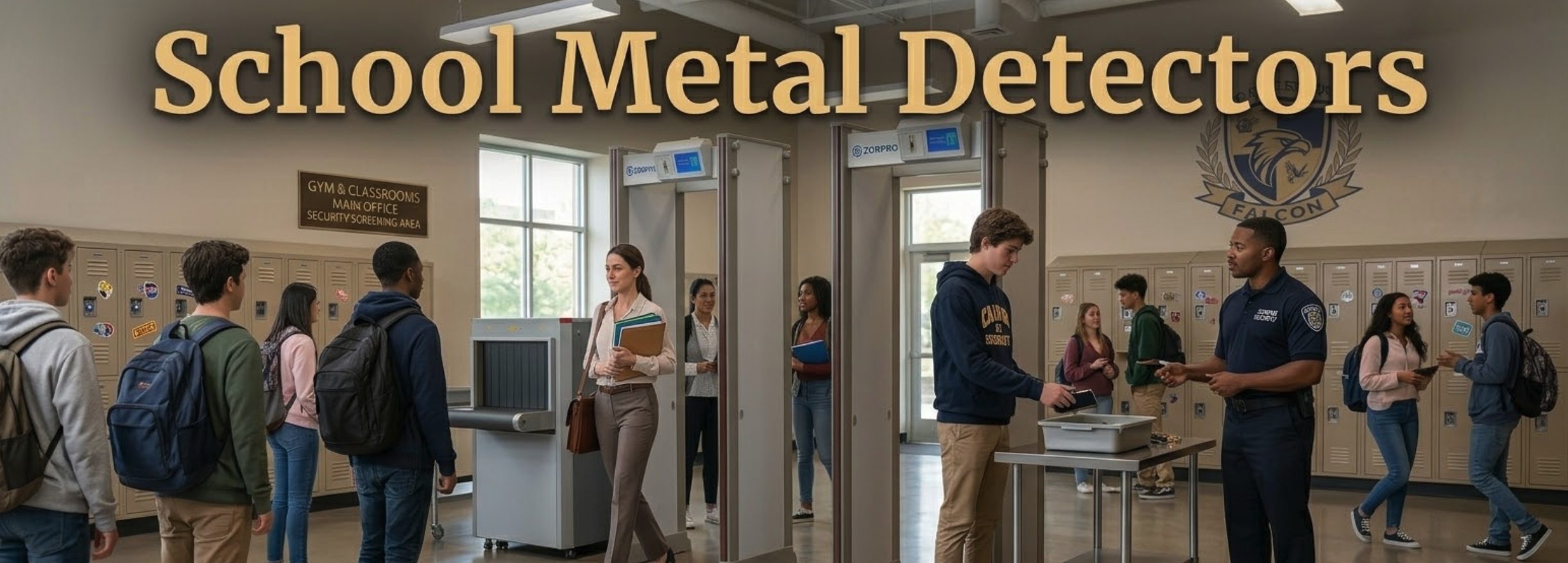
Choosing the right model depends on your student population, building layout, and budget. Here are the top performers currently leading the industry.
1. Garrett Paragon™: The Gold Standard
The Paragon is widely considered the most advanced walk-through detector available in 2026.
- Why it’s perfect for schools: It features 66 distinct detection zones. This allows security personnel to see exactly where an object is (e.g., left ankle vs. right pocket).
- Key Feature: Its “Zero Touch” NFC(Near-field communication) capability allows administrators to adjust settings via a smartphone, making it incredibly easy to manage across a large district.
- Throughput: Exceptional. It can handle high-density traffic during morning arrivals without causing a bottleneck.
2. CEIA OPENGATE®: The Non-Invasive Revolution
If your school wants to avoid the “airport feel,” the OPENGATE is the solution. It consists of two slim pillars without a crossbar.
- Why it’s perfect for schools: It is designed specifically to detect mass casualty weapons (like high-capacity firearms) while ignoring personal items like keys, phones, and belts.
- Key Feature: Students can walk through with their backpacks on. This is a game-changer for reducing morning lines.
- School Screening Systems Benefit: It’s portable and can be moved from the main entrance to the gymnasium for sporting events in minutes.
3. Garrett PD 6500i: The Reliable Workhorse
A staple in high-security environments for years, the PD 6500i remains a top pick for its rugged reliability and precision.
- Why it’s perfect for schools: It is highly “discriminatory,” meaning it is excellent at telling the difference between a weapon and a metal three-ring binder or a laptop.
- Key Feature: Multi-brand compatibility. If your school already uses other security hardware, the 6500i integrates seamlessly into most existing networks.
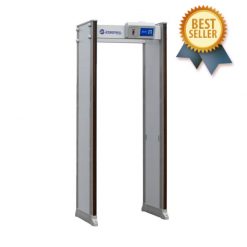
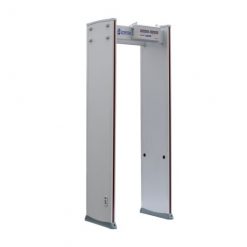
4. Zorpro 6 Zone: Best for Budget-Conscious Districts
Not every school has a massive security budget, but every school deserves protection. The Zorpro 6 Zone offers essential multi-zone detection at a lower price point.
- Why it’s perfect for schools: It provides the core safety benefits – ferrous and non-ferrous metal detection – without the high-cost “bells and whistles” of enterprise models.
- Key Feature: Lightweight and easy to assemble, making it ideal for schools that only require screening for specific events.
Setup Recommendations for Maximum Efficiency
Buying the hardware is only half the battle. Successful implementation of school security metal detectors requires a strategic operational plan.
1. Create a “Green Line” Flow
Position your detectors at least 10–15 feet away from the outer doors to prevent weather-related interference and to give students space to prepare. Use floor markings to show students where to stand and where to place their bags if secondary screening is required.
2. Standardize “Allowed” Items
To speed up the process, encourage students to use clear backpacks or move to digital-only materials. By reducing the “clutter” of metal school supplies, you reduce false alarms and keep the line moving.
3. Training is Key
A metal detector is only as effective as the person monitoring it. Ensure your staff is trained not just on the technology, but on “de-escalation” and “positive engagement.” Security should feel like a protective layer, not an interrogation.
Integrating Tech with Culture
While the focus here is on metal detectors for schools, these systems should be part of a “layered” security approach. This includes:
- Video Surveillance: For 24/7 monitoring of the perimeter.
- Access Control: Ensuring all other doors are locked and alarmed.
- Mental Health Resources: Addressing the root causes of school violence.
At PTI World, we believe that technology serves the people. Our 2026 fleet of screening systems is designed to be invisible when it’s not needed and infallible when it is.
Frequently Asked Questions (FAQs)
Q: Are school metal detectors safe for students with pacemakers or medical implants?
A: Yes. All the models recommended for 2026, such as the Garrett Paragon and CEIA OPENGATE, meet international safety standards (EMC) for human exposure and are safe for individuals with medical devices and pregnant women.
Q: Will metal detectors significantly delay students getting to class?
A: Not with modern systems. Models like the OPENGATE allow for a “walk-through” pace with backpacks on, handling up to 50–60 students per minute. Proper lane organization is the most important factor in speed.
Q: Can these systems detect non-metallic weapons?
A: Standard metal detectors are designed for metallic threats. However, many 2026 systems can be paired with AI-driven visual sensors or “dual-technology” scanners that can identify a wider range of prohibited items.
Q: How many detectors does a typical high school need?
A: A general rule of thumb is one detector for every 250–300 students if they are all arriving within a 20-minute window. Large schools often utilize multiple entry points to distribute the load.
Q: Do these systems require frequent maintenance?
A: Most modern school screening systems perform self-diagnostics upon startup. We recommend a professional calibration check once per semester to ensure sensitivity levels remain compliant with your district’s safety policy.
As we look toward the remainder of 2026, the integration of metal detectors for schools has become a hallmark of a responsible, safety-first district. By selecting high-throughput, high-discrimination models like the Garrett Paragon or the CEIA OPENGATE, schools can achieve the ultimate goal: a campus that is both open for learning and closed to threats.
Ready to upgrade your campus safety? Explore the full range of 2026 security solutions at PTI World and let our experts help you design a screening system that fits your school’s unique needs.